On this page:
As a key focus area of Te Aorerekura Action Plan (2025-2030)(external link) for the next two years, Keeping People Safe prioritises improving safety and support for those at highest risk of family violence and with complex needs, including children and young people.
No single organisation can keep people safe on its own. Yet too often, responses are fragmented, inconsistent, and difficult for families and whānau to navigate. Poor responses erode trust in the system, and victim-survivors are less likely to seek help.
The Centre for Family Violence and Sexual Violence Prevention (the Centre) is working to change this. In partnership with communities, iwi, government agencies and specialists, the Centre is driving a more connected, effective response – guided by the Family Violence Act 2018, informed by victim-survivors and shaped by the best available evidence.
Family violence is a serious and ongoing issue in Aotearoa New Zealand. Every year, thousands of people – disproportionately women and children - live with the fear and harm caused by family violence. Its impact reaches far beyond individuals, affecting families, whānau, communities and future generations.
The consequences can be severe. When agencies don’t act together, when risk is not clearly understood or acted on, people fall through the gaps - increasing the likelihood of ongoing violence, trauma, serious injury, or death.
What we know:
Around 92% of people involved in family violence deaths were already known to multiple agencies
Only 30-40 percent of people who experience family violence are known to the Police
Half of adult victims don’t ask for help at all
Across the country, local family violence responses have different levels of agency engagement, understanding of risk and use different tools and thresholds.
This leads to:
differences in the quality and types of services provided
inconsistent approaches to assessing and managing risk
uneven support for people, families and whānau, which can affect safety and access to help.
Wellington: Family Violence Death Review Committee (2017). Fifth Report Data: January 2009 to December 2015.
Timely, well-informed, and coordinated responses that help victim‑survivors reach safety sooner, reduce serious harm and deaths, and support healing.
To achieve safer outcomes for everyone affected by family violence, the Centre is supporting multi-agency responses to become:
whānau-centred, recognising the strengths, needs, and aspirations of whānau and families, including children and young people
locally led, with increasing leadership from community organisations or iwi social services rather than Police
supported by strong regional leadership
enabled by national settings that promote consistency, investment, and system-wide coordination.
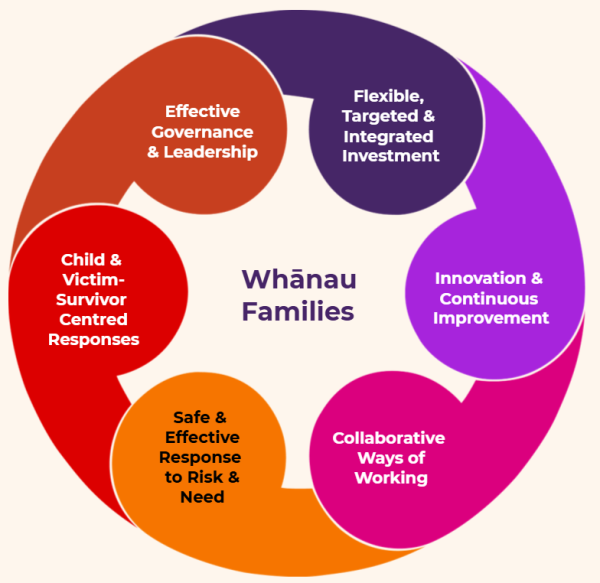
The Centre has developed an evidence-informed operating model to strengthen multi-agency responses to family violence. The Interdepartmental Executive Board(external link) approved the operating model in June 2025.
The evidence-informed operating model draws on local and international research, established good practice, and recent insights and data on what improves safety for people, families and whānau experiencing family violence.
It has also been shaped by input from family violence specialists, communities, iwi and government agencies.
The model identifies the core components required for effective multi‑agency responses, providing a consistent and robust foundation that can be adapted to local needs and contexts.
In 2026, the Centre is working with family violence specialists, government agencies, community organisations, and iwi social services to put elements of the operating model into practice.
An initial ‘test and learn’ phase is underway in Hawkes’ Bay, Tairāwhiti, Rotorua and Auckland City. This includes:
putting the new high-risk protocol and updated information sharing guidance into practice, supported by training and resources.
building workforce capability in key areas such as recognising when children and young people are at risk and how best to support them.
strengthening collaboration, governance, and leadership to improve accountability, drive implementation, and support continuous improvement. This includes clarifying agency roles and responsibilities and strengthening local-regional-national connections.
trialling a local-regional model in two regions to strengthen locally led family violence responses.
monitoring what works and what needs improvement to inform a wider rollout.
For any queries about the initial ‘test and learn’ phase, contact the Centre at keepingpeoplesafe@preventfvsv.govt.nz
A high-risk protocol has been developed to support national consistency in multi-agency responses for people, families and whānau at the highest risk of severe family violence.
The protocol was developed in 2025, and shaped through:
engagement with family violence specialists and communities with expertise and experience in multi-agency responses
input from government agencies through the Keeping People Safe Priority Steering Group
evidence from Aotearoa and international research
alignment with the Risk and Safety Practice Framework (RSPF).(external link)(external link)
In 2026, the high‑risk protocol will be piloted in four areas as part of testing and refining elements of the operating model.
A capable workforce is essential for strong multi-agency responses to family violence.
The Centre is strengthening workforce capability and consistency in training by:
publishing workforce capability frameworks that set clear expectations for safe practice and risk management
aligning training options to the skills outlined in these frameworks to support quality and consistency
embedding best practice in multi-agency responses at local and regional levels.
In 2025, a dozen family violence sites around the country developed their own System Improvement Plans with support from the Centre.
These plans:
assess each site’s current state
identify the shifts required and opportunities for improvement
outline changes to processes, functions, outcomes, and risk management
enable local innovation to meet diverse community needs and contexts.
Work to implement these plans is ongoing.
Specialist Outreach is a partnership between the Centre and local providers in Auckland City and Rotorua to strengthen multi-agency responses to family violence.
This initiative provides coordinated, intensive support for whānau and families at high risk of family violence. Services are delivered with community-led multi-agency responses to test specialist outreach alongside the high-risk approach.
In April 2025, the Minister for Family Violence and Sexual Violence Prevention launched(external link) the partnership alongside Ngāti Whātua Ōrākei and Manawa Tītī in Auckland.
The Centre proposed a new technology solution, Project Whetū, to transform how agencies share information safely and appropriately to support multi-agency family violence responses. It was seen as enabling more timely, well-informed decision-making to help families and whānau reach safety sooner.
In December 2025, the Board decided to pause Project Whetū, as there was no practical or sustainable way to host and operate the proposed platform at the time.
The Centre is now working with agencies and communities to strengthen the use and capability of the Police’s Family Safety System, building on existing technology to better support safe, effective information-sharing and coordinated multi-agency responses to family violence.
Last updated: 5 May 2026
Last modified: